
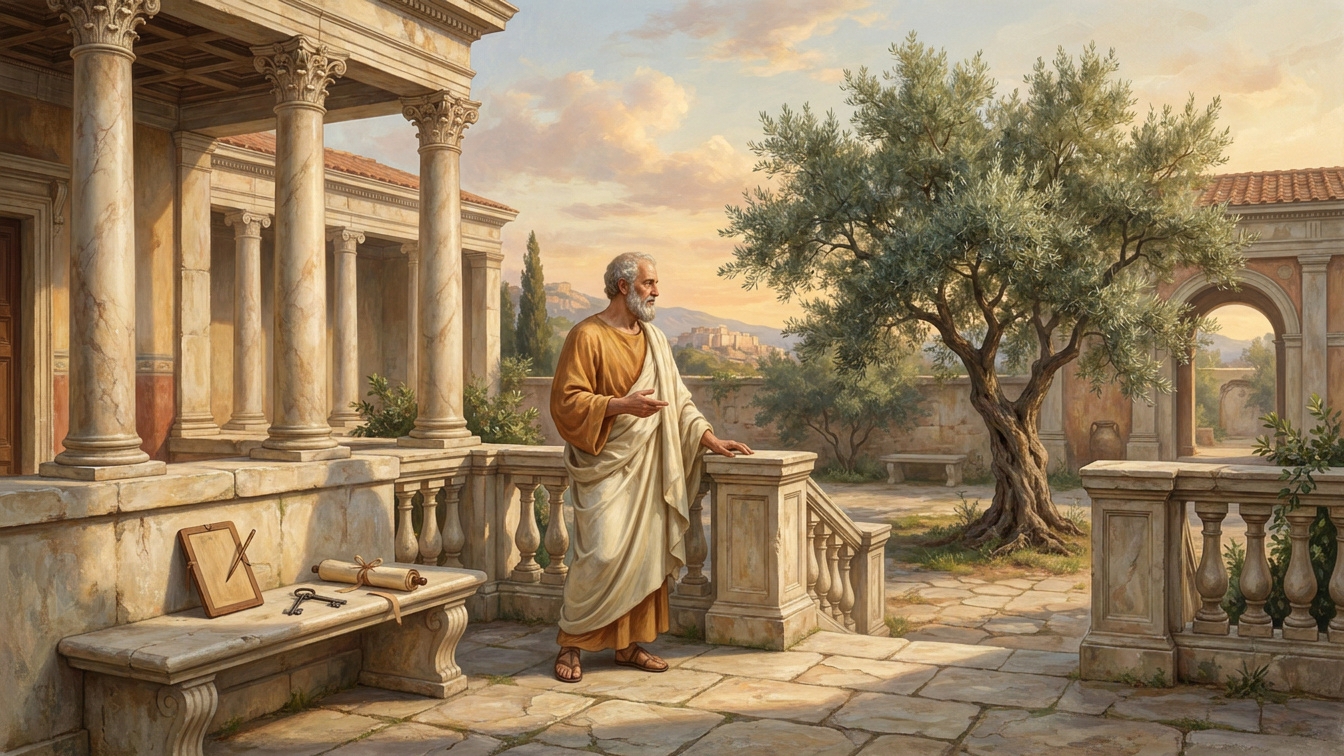
In the opening installment of this series, we adopted the procedure of the Stoic philosopher Athenodorus as recounted by Pliny the Younger (see Letters VII.27). Faced with a haunted house in Athens, he did not run in terror from the ghost that rattled its chains in the dead of night; instead, he calmly set down his writing tablet, followed the phantom out into the courtyard, and marked the spot where it vanished. The next morning, he instructed the magistrate to dig, unearthing the unburied bones of an ancient murder. Once those remains were properly interred, the house was forever freed from its haunting.
Across ten historical installments, we have been following the ghosts that haunt the house of modern education. We have tracked the jumbled, unexamined assumptions about human nature that quietly dictate our classroom methods, discipline policies, and curricular choices. We followed Plato’s dualist ghost into the courtyard, inheriting his noble vision of an immortal soul and the Socratic metanoia (repentance or conversion of mind), while reburying his speculative claims of pre-existence and bodily imprisonment. We unburied Aristotle’s integrated and hylomorphic soul, tracing the ladder of life to the rational climax of intellectual virtues, including both the technē (artistry or craftsmanship) of making and the phronēsis (practical wisdom or prudence) of moral action. We confronted the materialist shadows of Epicurus, giving “the devil his due” for presciently anticipating the physical nervous system, while rejecting his reduction of the Imago Dei to an atomic mechanism seeking mere ataraxia (or tranquility). We engaged the Stoic hegemonikon (ruling faculty of the mind), reclaiming the cognitive tools of pre-commitments and attention diversion while grounding the will in divine grace rather than self-sufficient pride.
As we moved into the modern era, the ghosts grew more aggressive. Descartes performatively severed the human person, leaving us haunted by a disembodied “ghost in a machine” that reduced the student to an isolated analytical thinker. Comenius offered a brilliant pansophic sanctuary, framing the child’s soul as a living seed and a spherical mirror designed to reflect the entirety of God’s cosmos. Yet the modern world largely chose the Cartesian split, leading inevitably to Freud’s tragic liquidation of the soul altogether by reducing the psychē to a mechanical apparatus driven by subterranean urges and leaving classrooms stranded between behaviorist manipulation and therapeutic conditioning. It was only in Charlotte Mason’s prophetic affirmation, “Children are born persons,” that the classical Christian tradition was triumphantly reunited, restoring dignity, unity, and spiritual agency to the child’s interior kingdom of “Mansoul.”

Now, in our contemporary moment, a new phantom confronts the classical classroom: the rise of empirical neurobiology and cognitive science. As brain imaging and neurophysiology expanded, secular commentators declared the final victory over the traditional soul, claiming that human thought, moral choices, and religious affections are nothing more than the automatic firings of prefrontal networks, the amygdala, and dopaminergic reward pathways.
Like Athenodorus, we must not retreat from these physical discoveries in fear, nor should we surrender to reductive physicalism. When we follow this modern neuroscientific ghost out into the courtyard of ideas, dig beneath the materialist rhetoric, and evaluate the empirical facts under the light of Christian orthodoxy, we uncover an astonishing truth: modern brain science does not liquidate the soul. Rather, it provides striking physical corroboration for an embodied, classical Christian view of human nature.
Reburying the Materialist Ghosts: Neurobiology and Hylomorphic Unity
To exorcise the modern classroom of both Cartesian disembodiment and Freudian determinism, we must ground our understanding in Thomistic hylomorphism (hylē, matter; morphē, form). Pioneered in Aristotle and matured by Thomas Aquinas, hylomorphism posits that a human being is a single, composite substance composed of matter (the biological body) informed by a substantial form (the rational soul). The soul is not simply an immaterial tenant lodged inside a physical engine; it is the spiritual internal organizing principle that gives life, structure, and distinct human capacity to the physical body.

Modern neurobiology aligns seamlessly with this classical synthesis, offering explicit biological mechanisms for how the embodied soul operates in a physical world.
1. The Physical Substrate of Abstraction (Conversio ad Phantasmata)
Aquinas famously maintained that during our earthly life, “the soul never thinks without a phantasm.” In other words, the intellect must turn toward physical sensory images (conversio ad phantasmata) to abstract universal truths. Modern neurobiology reveals that cortical structures and neural networks represent the exact physical substrate required for this sensory processing. When empirical imaging shows that brain damage or neurological activity alters cognitive or emotional output, it does not disprove the soul; it illuminates the physical organ through which the substantial form expresses itself.
2. Dual-Process Theory and the Proper Excellences of Nous and Epistēmē
In Thinking, Fast and Slow (Part I, Chapter 1), cognitive psychologist Daniel Kahneman distinguishes between System 1 (the brain’s rapid, implicit, pattern-recognizing cognitive processing) and System 2 (its slower, explicit, linear prefrontal reasoning).
The proper excellence of System 1 is nous (intuitive intellect or insight): the soul’s capacity to immediately grasp first principles, whole forms, and foundational premises through sensory experience or pure contemplation. The proper excellence of System 2 is epistēmē (scientific knowledge): the analytical capacity for step-by-step demonstration, logical deduction, and formal proof. When combined, nous and epistēmē yield sophia (philosophic wisdom), the ultimate perfection of the rational soul.
Dual-process theory demonstrates that true intellectual growth requires perfecting both pathways. Education must cultivate nous in System 1 through immediate sensory engagement, nature study, living stories, and contemplation, while simultaneously training epistēmē in System 2 through formal logic, rhetoric, and mathematical demonstration.
3. Subcortical Affectivity, the Amygdala, and Learning Science
As Glenn Whitman and Ian Kelleher highlight in Neuroteach, the brain’s emotional architecture directly conditions its capacity for academic learning. Subcortical structures, such as the threat-monitoring amygdala and the reward-driven dopaminergic system, process emotional stimuli prior to conscious prefrontal reflection. When a student experiences high anxiety or threat, the amygdala triggers a stress response that effectively hijacks cognitive function, downregulating the prefrontal cortex and preventing higher-level learning.
These subcortical dynamics map directly onto Aquinas’s account of the lower sensory appetites (the concupiscible and irascible passions). Recognizing these biological mechanics rescues students from being viewed as mere volitional failures, reminding educators that subcortical pathways must be reconfigured through peaceful environments, emotional regulation, and structured habituation rather than bare logical commands.
4. Myelination, Deep Practice, and the Tracks of Habit
In The Talent Code, Daniel Coyle explains how targeted, focused practice physically alters the architecture of the brain through myelination. Every time a student engages in deep practice, biological processes wrap layers of myelin (a fatty insulating sheath) around the active neural circuits. This myelination dramatically increases signal speed and accuracy, turning slow, deliberate effort into fast, automatic subcortical routines. Modern neurobiology provides the explicit physical mechanism for Charlotte Mason’s principle that habit is “ten natures” and that laying down physical tracks in the child’s brain frees up prefrontal executive bandwidth for higher contemplation and creative work.
5. Hemispheric Asymmetry and Relational Formation

In The Master and His Emissary (Part I, Chapter 2), psychiatrist and scholar Iain McGilchrist demonstrates how the Western world, and perhaps especially modern analytical schooling, has become heavily dominated by left-hemisphere processing, which favors abstraction, linear breakdown, and informational categorization. The right hemisphere, by contrast, mediates relational awareness, holistic perception, and narrative identity. Relational neural networks demonstrate that moral and spiritual formation operates primarily through right-hemisphere processing. Character is not formed by dumping propositional data into an analytical processor, but through storytelling, liturgy, communal worship, and shared rhythms of life.
Position Statement: The Classical Christian Doctrine of the Soul
Having followed the ghosts, excavated the errors, and retrieved the hard-won insights of the Western tradition, we affirm the following core position regarding the human person in education:
- Created as the Imago Dei: Every child sitting in our classrooms is created directly by God as a unified, living person: an embodied soul bearing the divine image. Human beings are neither biological animals to be conditioned nor software programs to be updated.
- Essential Hylomorphic Unity: The human person is an irreducible composite of body and soul. The soul is the internal organizing principle and substantial form of the body. We do not merely possess a body; we are embodied beings whose physical health, neurological states, and sensory experiences directly condition our moral and spiritual operations.
- Subsistent Immortality and Ultimate Destiny: While the soul relies upon physical sensory phantasms for earthly thought, it is a subsistent spiritual entity that outlives physical death by the divine will, and is created for eternal beatitude, divine communion, and the ultimate resurrection of the body.
- Rational Agency and Personhood: Equipped with Will, Reason, and an instructed Conscience, the child possesses authentic personal agency. Students are capable of real self-governance when nourished upon truth and fortified through disciplined habits of mind and body.

The Exorcised Classroom: Seven Principles of Embodied Pedagogy
When these historical and neurobiological truths are fully integrated, the “haunting” of our schools ends. The classroom is transformed from a site of behavioral management or disembodied lecture into a sacred space for forming whole persons. To realize this renewal, classical Christian education must follow seven foundational pedagogical commitments, ordered from the bodily foundation upward to divine contemplation.
1. Physical Gymnastic and Bodily Care
As a hylomorphic unity, the physical brain is the organ through which the soul expresses its earthly thoughts, meaning that physiological health directly conditions prefrontal executive control. Classical Christian education must treat aspects of physical care, like nutrition, proper sleep, outdoor nature exploration, posture training, and vigorous physical conditioning (gymnastic), not as non-academic extras, but as essential spiritual prerequisites for intellectual and moral growth.
2. Subcortical Regulation and Affective Peace
Because lower subcortical systems like the threat-monitoring amygdala and dopaminergic reward pathways process stress and craving before conscious reflection occurs, educators must proactively cultivate an atmosphere of safety and emotional peace. Classroom leadership must reject fear-based intimidation or artificial reward systems that trigger hyper-reactive stress responses or dopaminergic addiction. Instead, teachers must establish calm, predictable, and orderly classroom environments that soothe autonomic stress, enabling the prefrontal cortex to remain engaged for higher order thinking and virtue development.
3. Neuroplastic Myelination and Habit Training

Modern neurobiology confirms that deep practice and repeated behaviors trigger myelination along neural pathways, converting deliberate moral choices into automatic subcortical routines. By cultivating habits of mind and body early, such as sustained attention, prompt obedience, truthfulness, order, and neatness, educators build myelinated circuits that free up prefrontal executive bandwidth. Furthermore, by teaching students the Stoic-Christian tools of diversion and pre-commitments (“bright lines”), we equip them to command their attention and exercise genuine self-governance.
4. Liturgical, Aesthetic, and Relational Formation
Because moral identity and right-hemisphere neural processing are shaped through narrative, harmony, and relational rhythms rather than bare propositional data, our schools must intentionally tune the sensory appetites. We must immerse students in regular rhythms of chapel, liturgical singing, poetry recitation, visual art, nature study, and reverent school routines. These aesthetic disciplines calm autonomic stress systems, tune the lower passions, and order the student’s loves toward the Good, the True, and the Beautiful.
5. The Science of Relations and Living Ideas
Because the child’s soul is a perceptual abyss created as the Imago Dei to reflect the beauty and order of the cosmos, the mind naturally craves and feeds upon living truth. Educators must provide a vast, generous, and interconnected curriculum of Great Books, history, mathematics, science, and fine art. We must fiercely resist truncating education into narrow, utilitarian skill training, standardized test preparation, or vocational specialization.
6. Self-Activity, Narration, and the Dual Virtues (Nous and Epistēmē)
Thomistic hylomorphism reminds us that intellectual abstraction requires the active turning of the mind to sensory phantasms (conversio ad phantasmata). To cultivate the proper excellences of both System 1 (nous) and System 2 (epistēmē), schools must replace passive teacher lectures with Charlotte Mason’s practice of daily oral and written narration, with Socratic dialogue, and with direct student interaction with primary sources. These activities exercise both nous, as the student intuitively grasps and assimilates the living idea, and epistēmē, as they synthesize and articulate its logical connections in their own words.
7. Guided Interiority and Divine Illumination
Following Augustine, we recognize that human words are mere outward admonitions; Christ, the Inner Teacher, grants genuine intellectual light and understanding to the rational soul. Educators must teach students the discipline of attention and the “Sabbath of the mind,” creating spaces of quiet reflection, contemplative prayer, and rigorous inquiry. We lead students from simple acceptance of authority to personal rational insight, helping them cling to Unchanging Truth through their own restored reason.

Conclusion: Restoring Glory to the Educational Enterprise
When Athenodorus finished his work in the courtyard, the ghost was seen no more, and the house in Athens became a place of peace, clarity, and life.
By following the ghost of the soul through the Great Conversation and unearthing the false assumptions of reductionism and dualism, we arrive at a vision of education that is profoundly physical, intellectual, and eternal. We do not teach biological machines to be programmed, nor isolated ghosts to be informed. We teach immortal persons: embodied souls designed to know, love, and reflect their Creator. When our classrooms embody this truth, we end the haunting of modern reductionism and restore lasting glory, sacred dignity, and transcendent hope to the soul of education.
Works Cited
- Aquinas, Thomas. Summa Theologiae. Translated by the Fathers of the English Dominican Province. New York: Benziger Brothers, 1948.
- Aristotle. De Anima (On the Soul). Translated by W. S. Hett. Loeb Classical Library. Cambridge, MA: Harvard University Press, 1957.
- Aristotle. Nicomachean Ethics. Translated by H. Rackham. Loeb Classical Library. Cambridge, MA: Harvard University Press, 1926.
- Augustine. The Magnitude of the Soul. Translated by John J. McMahon, S.J. In The Fathers of the Church: A New Translation, Vol. 4. New York: Fathers of the Church, Inc., 1947.
- Cicero. Tusculan Disputations. Translated by J. E. King. Loeb Classical Library. Cambridge, MA: Harvard University Press, 1927.
- Comenius, John Amos. The Great Didactic of John Amos Comenius. Translated by M. W. Keatinge. London: Adam and Charles Black, 1896.
- Coyle, Daniel. The Talent Code: Greatness Isn’t Born. It’s Grown. Here’s How. New York: Bantam Books, 2009.
- Descartes, René. The Passions of the Soul. Translated by Stephen H. Voss. Indianapolis: Hackett Publishing Company, 1989.
- Epicurus. The Extant Remains. Translated by Cyril Bailey. Oxford: Clarendon Press, 1926.
- Freud, Sigmund. Civilization and Its Discontents. Translated and edited by James Strachey. New York: W. W. Norton & Company, 1961.
- Kahneman, Daniel. Thinking, Fast and Slow. New York: Farrar, Straus and Giroux, 2011.
- Lucretius. On the Nature of Things. Translated by W. H. D. Rouse, revised by M. F. Smith. Loeb Classical Library. Cambridge, MA: Harvard University Press, 1992.
- Mason, Charlotte M. Towards a Philosophy of Education. Vol. 6 of the Home Education Series. London: Kegan Paul, Trench, Trübner & Co., 1925.
- McGilchrist, Iain. The Master and His Emissary: The Divided Brain and the Making of the Western World. New expanded ed. New Haven: Yale University Press, 2019.
- Plato. Phaedo and Republic. Translated by B. Jowett. Oxford: Oxford University Press, 1892.
- Pliny the Younger. Letters (Book VII, Letter 27: “To Sura”). Translated by W. M. L. Hutchinson. Loeb Classical Library. Cambridge, MA: Harvard University Press, 1915.
- Whitman, Glenn, and Ian Kelleher. Neuroteach: Brain Science and the Future of Education. Lanham, MD: Rowman & Littlefield, 2016.

Leave a Reply