
In our ongoing series, we have been working like the Stoic philosopher Athenodorus, following the ghost of our philosophical assumptions about the soul out into the courtyard of historical ideas to discover what must be retained and what must be reburied. So far in our chronological survey we have engaged with the tripartite harmony of Plato, the hylomorphic unity of Aristotle, the rival materialist schools of the Epicureans and Stoics, Augustine’s spiritual magnitude of ascent, and the integrated synthesis of St. Thomas Aquinas. Yet, as we move into the seventeenth century, we encounter a figure whose “surgical” approach to the human person would eventually shatter this classical and medieval landscape. It is here that the ghost we have been following finally turns around, haunting the house of modern pedagogy in a uniquely fragmented way.

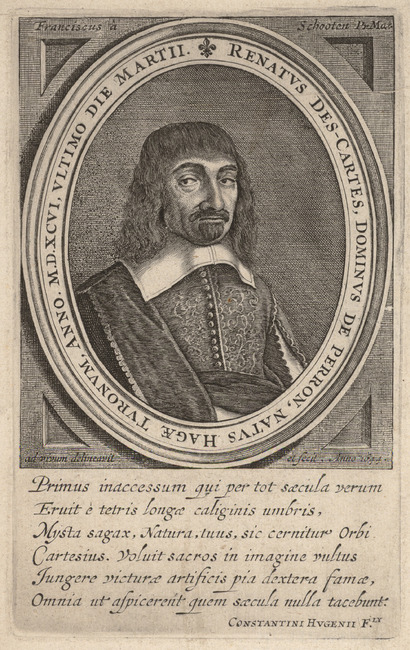
René Descartes (1596–1650) was a man of the Enlightenment. Born in France and educated by the Jesuits at the College of La Flèche, he was a creative mathematician of the first order—the inventor of analytical geometry—and a primary architect of the Scientific Revolution (Hatfield 2023, §1 and §4). To understand Descartes, one must first sympathize with his “Project of Pure Inquiry,” rather than simplistically blaming him for all the problems of modernity (a common misstep among academics today). Living in an era of profound skepticism, intellectual instability, and devastating religious warfare, Descartes sought a foundation for human knowledge that was as stable, indisputable, and mathematically precise as a geometric proof. He was not a nihilist seeking to destroy truth, but a builder who believed that if the human mind could be delivered from the fog of scholastic jargon and unexamined tradition, it could achieve absolute certainty.
This noble pursuit of certainty led him to a dramatic psychological experiment: he would systematically demolish the “shaky structure” of his own inherited beliefs to see if any bedrock remained. Sitting alone in a stove-heated room during a winter campaign, Descartes resolved to treat every sensory experience—the warmth of the fire, the sight of his own hands, the sound of voices—as a potential deception engineered by a hypothetical “malicious demon” dedicated to tricking him (Descartes 1641, Meditation I, p. 3). His experiment in skepticism might be considered the dramatic birth of modern rationalism. By retreating from the “frail and mortal” testimony of the physical senses, he sought a foundational truth that was entirely “clear and distinct,” providing an unshakeable starting point for the sciences: cogito, ergo sum (“I think, therefore I am”).
The Definition of the Soul as “Thinking Thing”
In his Meditations on First Philosophy (1641), Descartes reaches the dramatic climax of his stove-side experiment. Having doubted his senses, his memories, and the very existence of the physical world, he realizes that the act of doubting itself requires an agent. Even if a malicious demon is deceiving him about his body, he must exist in order to be deceived. He famously concludes:
“Well, then, what am I? A thing that thinks. What is that? A thing that doubts, understands, affirms, denies, wants, refuses, and also imagines and senses…. Isn’t all this just as true as the fact that I exist, even if I am in a perpetual dream, and even if my creator is doing his best to deceive me? Which of all these activities is distinct from my thinking? (Descartes 1641, Meditation II, p. 5, 6)
Although Descartes is admittedly not proposing a formal definition of the soul, his implicit reduction of it to a “thinking thing” represents a radical departure from the Aristotelian view of the soul as the “principle of life” that had dominated Western thought for centuries. For the earlier classical and medieval thinkers we have examined, the soul (psyche or anima) was inextricably bound up with biology; it was the very thing that made a physical body alive, governing everything from the digestion of nutrients (the vegetative soul) to locomotion and sight (the sensitive soul) (see Aristotle, De Anima II.1). In Descartes’ hands, however, the soul is surgically removed through radical skepticism from the biological world and redefined strictly as consciousness. The soul is no longer the animating principle of the physical limbs; it is solely the thinking principle of the mind.
This move echoes the “Incorporeal Ascent” of St. Augustine, who also prioritized the inner certainty of the mind over the external world, noting that truth is found by turning inward (see Augustine, The Magnitude of the Soul). However, the ultimate telos of this interiority is vastly different. Where Augustine saw the mind’s inward focus as a bridge to divine illumination—a way for the whole person to rise toward a personal Creator—Descartes uses it as a fortress of secular, epistemic autonomy. By implicitly narrowing the soul’s definition to purely intellectual acts (doubting, affirming, willing), he effectively and perhaps unwittingly “de-souls” the rest of the human experience. If the soul is just a “thinker,” then the physical growth of a child, the development of their physical health, and the training of their bodily habits are no longer seen as vital components of “soul-work,” but as mere biological maintenance of a peripheral shell.

The Real Distinction: The Great Split
Having established the certainty of the thinking self, Descartes proceeds to define the nature of the body in relation to that self. He argues for what he calls a “real distinction” between two entirely different types of created substances, using his mathematical logic to ensure they never touch:
“I have a vivid and clear idea of myself as something that thinks and isn’t extended, and a clear idea of body as something extended that does not think. So it is certain that I am really distinct from my body and can exist without it.” (Descartes 1641, Meditation VI, p. 29)
This Great Split represents the systematic dismantling of the Thomistic synthesis that we examined in our last installment. At first it might seem as if Descartes has established the immortality of the soul apart from the body just like Aquinas. Yet St. Thomas Aquinas worked tirelessly to preserve the unity of the human person, demonstrating that the soul is the “substantial form” of the body—that the two are as inseparable as the shape of a statue is from its bronze material (ST I, q. 76, a. 1). For Aquinas, “man is not a soul only, but something composed of soul and body,” and the soul requires the body to achieve its natural perfection (ST I, q. 75, a. 4). Descartes shatters this unity with his mathematical logic of exclusion. He argues that the mind is entirely simple and indivisible, whereas the body is by its very nature divisible into parts. Because these two things have mutually exclusive properties—one being an “unextended” thought and the other being “extended” matter taking up space—they must, by logical necessity, be completely separate substances.
By formalizing this distinction, Descartes takes the dualism of Plato—who viewed the body as a temporary “cage” or “prison” for the soul—and gives it a new, rigid ontological permanence. In Plato’s view, the soul was superior to the body, but they were still parts of a unified moral narrative, interacting through the affections. In the Cartesian system, they are two different kinds of “stuff” altogether. There is no longer a middle ground, no “spirited part” or thumos (“chest” or “heart”) to bridge the gap; there is only the logic of the unextended mind and the physics of the extended body. That a particular soul could be the form of this human body does not even occur to him.
This development in historical views of the soul effectively kills the classical idea of embodied learning, paving the way for the factory model of modern education. This is because Descartes’ view suggests that the “real” student is a disembodied intellect, and that the physical classroom, the child’s posture, and their sensory engagement are merely accidental backdrops rather than essential components of their human learning.
Furthermore, this split creates an insurmountable barrier for the teacher. If the student’s mind is a private theater completely distinct from their material body, how does the external world—the books, the teacher’s voice, the physical math manipulatives—ever actually reach the soul? For Aquinas, the “phantasm” or sensory image was the indispensable bridge between the physical world and the spiritual mind, because the soul naturally turned to sensory images to abstract universal truths (see ST I, q. 84, a. 7). For Descartes, the mind is so radicalized in its separation that sensory data is always suspect, treated as a mere physiological signal to be deciphered by a detached observer. His radical skepticism has split the soul from its body. This loss of the hylomorphic bridge leaves modern education in a perpetual state of skepticism, constantly questioning whether the physical work of the classroom has any true, formative impact on the student’s inner life.

The Body as Machine
With the soul no longer acting as the “form” or organizing principle of the body, Descartes was forced to explain biological life in purely mechanical terms. If the soul does not make the body alive, then the body must be a self-powering mechanism. He looked to the hydraulic water-fountains of the royal gardens for his primary metaphor, imagining the “animal spirits” as the water pumping through the valves and the nerves as the pipes:
“I would like you to consider that these functions follow from the mere arrangement of the organs, which is no more and no less than the movement of a clock or other automaton follows from the arrangement of its counter-weights and wheels.” (Treatise on Man, p. 113)
The key phrase and philosophical misstep can be found in the words “mere arrangement” and “no more… than”: the language of reductionism. In this move, Descartes leans heavily into the materialist tradition of the Epicureans. Like Lucretius, whom we studied in Part 4, Descartes explains the “passions,” the digestion, and the automatic movements of the limbs through the “arrangement of organs” and mechanical friction (see Lucretius, De Rerum Natura). He accepts the materialist premise for the physical self entirely. The difference is that while Epicurus was a monist who believed the entire person was a mortal atomic machine, Descartes tried to keep a rational, immortal “pilot” in the cockpit. He wanted the supposed scientific benefits of a mechanical body to advance physics and medicine, but he sought to avoid the theological cost of a mortal soul.
However, by surrendering the body to the realm of pure mechanics, Descartes inadvertently reduced the person to a biological system to be managed rather than a life to be shared. He famously discussed the pineal gland as the precise point in the brain where the “ghost” pulls the levers of the “machine” (Descartes 1649, Art. 31), a modern attempt to locate what the Stoics had earlier called the Hegemonikon—the “ruling part” of the soul. But unlike the Stoic ruling part, which was a physical extension of a unified, fiery breath (pneuma) woven into the senses like a spider in its web, Descartes’ ruler is an alien within its own home. This mechanical view effectively stripped the wonder from the human body. The heartbeat is no longer the rhythm of a person; it is the ticking of a clock.
For the educator, this turns child development into a series of biological milestones to be tinkered with rather than a sacred unfolding of an integrated person. This reduction of the physical body to an automaton had a chilling effect on the view of human labor and physical habit. If the body is just a clockwork mechanism, then the training of the hand or the eye is merely a matter of mechanical conditioning. We might even say that Descartes inadvertently paved the way for psychological behaviorism. The classical view—that our physical habits are like the garments of the soul—is replaced by the idea of technical proficiency. We no longer train a child’s posture to reflect an internal state of reverence; we manage their physical behavior to ensure they don’t interfere with the information processing of the mind. The body becomes something to be “stilled” or “optimized” so that the ghost can get on with its thinking, thereby undercutting the moral and spiritual value of physical action.

Pedagogy and the “Bloated Head”
The implications for education are profound and, from a classical perspective, largely negative. While we may admire Descartes’ desire for mathematical precision and his defense of the mind’s dignity against pure materialism, his metaphysics leaves the educator with a fragmented subject—a child who has been split in two.
1. The Rise of “Bloated Head” Pedagogy:
If the soul is strictly a “thinking thing,” then education becomes a process of informing the mind while the body is treated as a passive accessory. We see this in classrooms where children are expected to sit still for hours, divorced from the rich sensory and imaginative experience Aristotle deemed necessary, as we focus entirely on the internal theater of the mind. We treat students as “brains on sticks,” forgetting that the vegetative and sensitive powers of the soul—health, movement, and habit—are the soil in which the intellect grows. When we prioritize abstract “critical thinking skills” over the cultivation of the whole person, we are the heirs of Descartes.
2. The Mechanical Child:
By treating the body as an automaton, Descartes provided the philosophical foundation for the theories of classical conditioning and modern behaviorism. When we treat students as biological machines to be conditioned through “input and output” rather than persons to be formed, we are operating on Cartesian premises. We lose the sense of the living form where learning is a natural growth. If the body is just a machine, then “discipline” becomes “mechanical management” rather than the “reorientation of the heart” seen in the Augustinian tradition. We begin to look for behavioral “fixes” and “buttons” to push in a child’s environment rather than appealing to their unified nature as a person.
3. The Loss of the Heart:
Because Descartes defined the soul purely through logic and consciousness, he struggled to account for the “spirited part” of the soul—the thumos that Plato identified as the white horse of motivated action (Plato, Phaedrus). In a Cartesian world, education is for the intellect, while the affections are left to the mechanics of the body. This is exactly what C.S. Lewis warned against in The Abolition of Man: we create “men without chests” because we no longer have a unified anthropology that recognizes the heart as the mediator between mind and body. We have a “ghost” that can think about virtue in a detached, academic way, but a “machine” that has no trained desire to act upon it.

Against this fragmented Cartesian legacy, the classical educational renewal must look back to a figure who offered a “road not taken” at the dawn of the modern era: John Amos Comenius (1592–1670). Comenius, whose view of the soul we will explore in the next article, recognized that the burgeoning scientific age required a systematic approach to schooling, yet he refused to surrender the unified, hylomorphic anthropology of the Thomistic synthesis. Through his pansophic vision, Comenius asserted that the human soul remains a singular life principle—encompassing the vegetative, sensitive, and rational capacities—fashioned as a living “seed-plot” and a “mirror” of God’s glory that must encounter the fullness of the visible world (Comenius 1649). By treating the child as an unqualified personal unity rather than an isolated ghost pulling the levers of a clockwork machine, Comenius provides the historical bridge needed to restore holistic, embodied learning to our contemporary pedagogical practices.
As we conclude this part of our series, we see that Descartes’ “ghost” has left us haunted by a fragmented view of our students. We have traded the “Whole Person” for a fragmented “Thinker,” and in doing so, we have made the “Soul of Education” a very small and lonely thing. We are left trying to educate a mind that has no essential connection to its hands, its heart, or the world it inhabits. To find a way out of this jumbled mess, we must continue our journey through the courtyard of ideas, following the trail toward Comenius to see how the “Paradise of the Heart” can master the mechanisms of the machine.
References
Aquinas, Thomas. Summa Theologiae. Translated by the Fathers of the English Dominican Province. New York: Benziger Brothers, 1920.
Aristotle. De Anima. Translated by J.A. Smith. In The Complete Works of Aristotle, edited by Jonathan Barnes. Princeton: Princeton University Press, 1984.
Comenius, John Amos. The Great Didactic. Translated by M. W. Keatinge. London: A. and C. Black, 1896. (Original work published 1649).
Descartes, René. Meditations on First Philosophy. Translated by Jonathan Bennett. Early Modern Texts, 2017. https://www.earlymoderntexts.com/assets/pdfs/descartes1641.pdf.
Descartes, René. The Passions of the Soul. Translated by Jonathan Bennett. Early Modern Texts, 2017. https://www.earlymoderntexts.com/assets/pdfs/descartes1649.pdf.
Descartes, René. Treatise of Man, trans. Thomas Steele Hall. Cambridge, MA: Harvard University Press, 1972).
Hatfield, Gary. “René Descartes.” The Stanford Encyclopedia of Philosophy. Edited by Edward N. Zalta. Fall 2023 Edition. https://plato.stanford.edu/archives/fall2023/entries/descartes/.

Leave a Reply