
In this series, we have been analyzing the views of the soul in the great thinkers and philosophies of the western tradition. Our working thesis is that our anthropology will inform our pedagogy, even and perhaps especially when we are unaware of our philosophical assumptions, which are often a jumbled up mess. Like an attic box of knick knacks, inherited unwittingly from earlier generations, these different notions of the human soul influence our educational practices. We are endeavoring to take them out piece by piece, reviewing their stories and uses, as well as their role in our family history. Such a critical and constructive process is intended to free us from following the unexamined pedagogies of this modern mess.
So far we have engaged with the tripartite harmony of Plato, the hylomorphic unity of Aristotle, and the materialist challenges of the Epicureans and Stoics. While the Stoic hegemonikon provided a rigorous framework for training the will, its radically corporeal nature—defining the soul as a material, fiery breath (pneuma)—leaves the Christian educator yearning for a more transcendent foundation. The Stoic soul, despite its noble pursuit of virtue, remains a mere fragment of the material universe, ultimately perishable and bound by the physical laws of tensility.

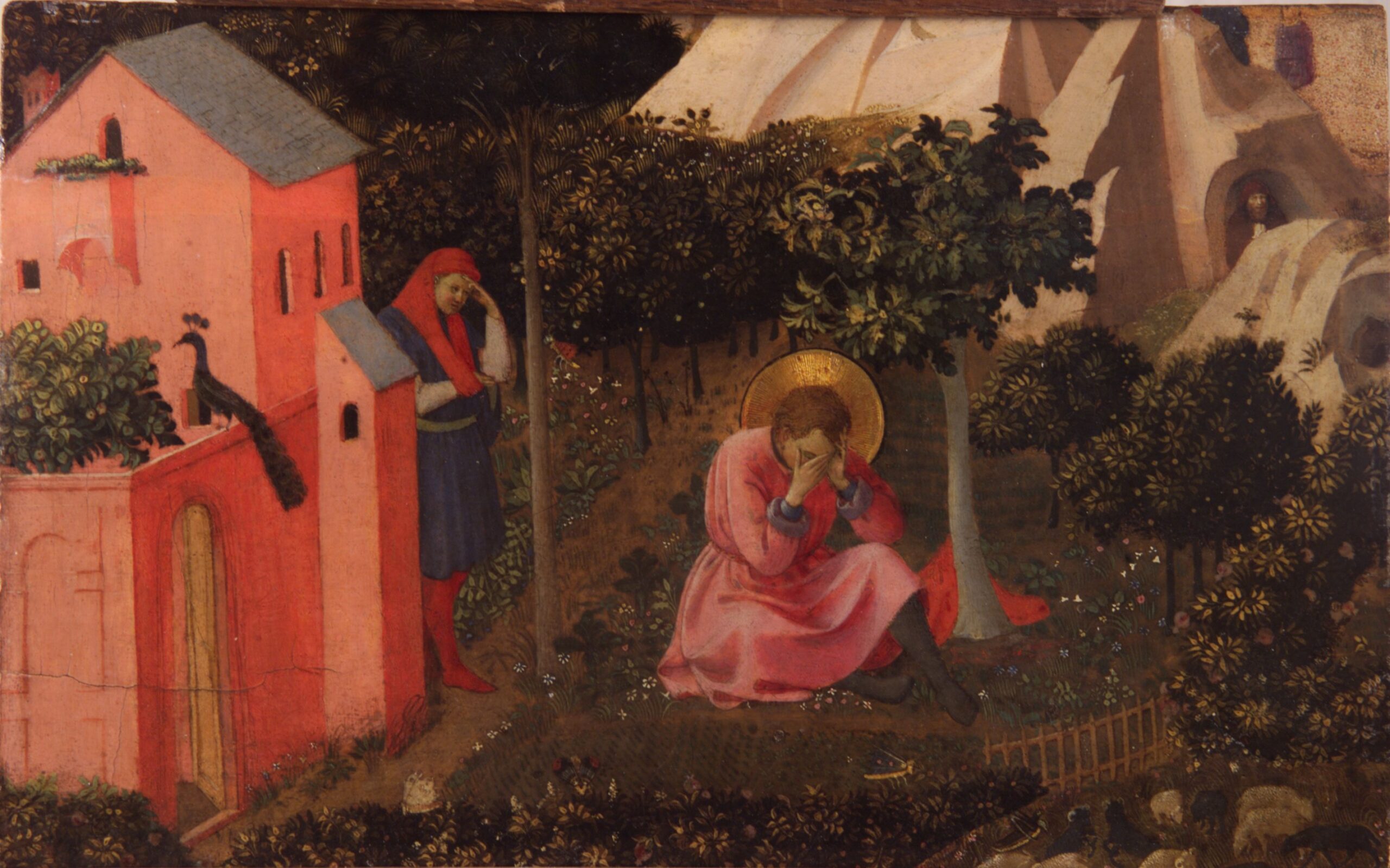
Now we turn to Saint Augustine of Hippo, the first philosopher-theologian in the Western Christian tradition to compose a formal treatise on the immortality of the soul (Tornau, “Augustine of Hippo,” Stanford Encyclopedia of Philosophy). Born in 354 in Thagaste, Roman Africa, Augustine’s path to Christian truth was long and circuitous. He was first inflamed for philosophy at age eighteen by reading Cicero’s Hortensius, but spent nine years as a “hearer” in the dualistic Manichean sect before encountering the “books of the Platonists” and the preaching of Bishop Ambrose in Milan.
Augustine’s view of the soul represents a pivotal revolution for our classical Christian education renewal, because of how it synthesizes a Neoplatonic metaphysics with the ultimate authority of biblical revelation. In this way, he will move the Great Conversation about the nature of soul from material mechanics to a theology of interiority and illumination. Augustine insists that the soul is not a refined physical gas, spread throughout the body, but a unique, incorporeal substance whose very nature is oriented toward the personal contemplation of Unchanging Truth.
Refuting Corporealism: The Soul’s Transcendence
Augustine begins his psychological inquiry by aggressively distancing himself from the materialist schools of late antiquity. While the Stoics argued that the soul must be a body because only bodies can act or be acted upon, Augustine asserts that the mind’s ability to grasp unchanging, non-spatial truths proves its incorporeal nature. In his dialogue The Magnitude of the Soul, he provides the following definition of soul:
“If you wish a definition of what the soul is, I have a ready answer. It seems to me to be a certain kind of substance, sharing in reason, fitted to rule the body.” (83)
The dialogue with Euodius has taken a long and circuitous (though geometric) path to get to this formulation in chapter 13. By defining the soul as a substance (substantia), Augustine grants the mind a reality independent of the body’s physical organization, contra a limited reading of Aristotle. In addition, he has explicitly refuted the idea that the mind is merely a biological harmony or organization of the body (Immortality of the Soul, 35-37). Rather, the soul is said to share in reason, which Augustine identifies elsewhere as the “vision of the mind,” the faculty that allows us to perceive intelligible realities like justice or mathematical principles. Finally, the soul is fitted to rule, establishing a clear ontological hierarchy where the teacher’s task is to help the student’s rational soul maintain its rightful dominion over the physical appetites and the many-headed beast of the passions (thereby recalling Plato, but identifying soul with the highest rational part).
Augustine’s argument for the soul’s incorporeality relies on the mind’s lack of magnitude of extent. Unlike a body, which can be measured in length, width, and height, the soul possesses no spatial dimensions; if it did, it would be divisible, and we could theoretically “cut” our minds in half (Intro of Magnitude of the Soul, 52). He illustrates this for Euodius through the concept of a geometrical point, which serves as the origin of a line but occupies no space itself (see 83). Just as a point is the powerful source of a line’s existence, the soul is the non-spatial source of life and movement in the body. This refutation of materialism would require that our education of students be treated as a spiritual encounter rather than a physical molding of brain matter–a pitfall that we may be even more in danger of falling into in our day, than in they were in late antiquity.

Because the soul is a non-material “substance” or form of being, it is capable of a non-spatial presence within the body. Augustine argues that the “whole soul is in all the body and in each of its individual parts,” which for him explains why we feel a sensation in our toe immediately even though the “ruling part” might be said to reside in the chest or head (The Immortality of the Soul, 46). This “magnitude of power” over space is what differentiates the human person from a mere machine. From the modern discovery of the brain and nervous system, we might be tempted to look askance at this total presence of the soul in each part of the body. But arguably this is because we still tend to equate the soul with brain activity, or with a subsystem required for bodily life, like the heart beating or lungs breathing. Augustine would claim that, for biblical statements about the soul’s ongoing existence after death to be true, it must be fundamentally incorporeal as well immortal.
This development from earlier thinkers becomes even clearer when we notice the linguistic and conceptual shift that has occurred. We are now considering the soul not primarily as the bodily principle of life, but as the human spirit that is immortal, surviving bodily death, and therefore not dependent ultimately on any part of the physical body. This Christian view of the soul (which bears some resemblance to Neoplatonism) seems to require presence within and throughout the body during life, but precludes dependence on the body or any of its parts. For the educator this vision of the greatness of each student’s soul effects nothing short of a revolution in mindset, as Charlotte Mason likewise claimed for her doctrine (“Children are born persons.”). According to Augustine, each student is a unified spiritual agent, an incorporeal being who must be educated according to her unique dignity rather than mere biological utility.

The Seat of Science and Necessary Truth
While the Stoic pneuma was a refined material breath, Augustine insists the soul is entirely incorporeal—it has no length, breadth, or thickness (The Magnitude of the Soul, 74). For the educator, this is not merely a point of physics but of power. If the soul were material, learning would be a matter of “filling” a container or “imprinting’” a wax tablet—metaphors often used in modern education as well as behaviorism. Instead, because the soul is incorporeal, it is not a passive recipient of data but an active, living agent. Education, therefore, is not the accumulation of material facts, but the stretching of a non-material capacity—the inner sense—to grasp truths that do not occupy space.
While the Stoics and Epicureans sought tranquility through material detachment or the avoidance of pain, Augustine seeks it through the immutability of Truth. In The Immortality of the Soul, he develops a profound argument based on the nature of systematic knowledge, which he calls “science” (the Latin is disciplina, but it functions in a way that is conceptually similar to Aristotle’s use of the Greek episteme). He reasons that since “science” consists of true, unchanging principles—such as the mathematical fact that “the sum of two and two is four”—it can only exist in a subject that is also alive and everlasting:
“Moreover, science is somewhere, for it exists, and whatever exists cannot be nowhere. Again, science can exist only in that which lives. For nothing that does not live learns anything… since the truth can only exist in an incorporeal substance that is alive… the soul must everlastingly live.” (16)
For the classical educator, this “seat of science” argument elevates the curriculum from career preparation through training in useful skills to the contemplation of necessary truth. If the student’s mind is the dwelling place of eternal principles, then education is not about filling a “blank slate” with contingent data, but about illumination. Augustine argues that since truth is “the highest degree of changelessness,” the mind that adheres to it must be fundamentally better and “more alive than the body” (The Immortality of the Soul, 29). The body, by contrast, is “mutable” and moves only in time, whereas the mind can hold the past, present, and future simultaneously through memory and expectation (20).
This focus on necessary truth provides the deepest justification for early training in the liberal arts. Subjects like Mathematics and Dialectic are not merely tools for commerce; they are “immovable pillars” that associate the mind with realities that are “not contained in space” (Augustine, The Immortality of the Soul, 36). When students come to understand a geometrical proof, they are engaging in an “act of our mind” that is “free from every semblance of falsehood” (16). This contact with the eternal “vivifies” the soul, preventing it from “tending toward nothing” through the “defect” of ignorance and foolishness (30).
Furthermore, Augustine’s theory of knowledge protects the student from the skepticism prevalent in both his age and our own. While postmodernism argues that truth is a relative social construct, Augustine insists that “correct reasoning without science is impossible” (The Immortality of the Soul, 16). Because the mind is the “seat” of these immutable truths, every student possesses a “vision of the mind” (ratio) that allows them to “see” the truth for themselves (The Magnitude of the Soul, 90).

The Magnitude of Power: Seven Degrees of the Soul
In the classical renewal movement, we often speak of the integrated formation of the human person. Augustine provides a masterful roadmap for this development in The Magnitude of the Soul, where he distinguishes between magnitude of extent (physical size) and magnitude of power (virtues and abilities). He drily remarks that if virtue resulted from the size of the body, then “the taller or stronger a man is, the more prudent he should be,” a conclusion clearly contradicted by reality (90). Instead, he outlines seven levels of the soul’s power that function as a hierarchy for educational growth. As the translator John McMahon summarizes in the Introduction:
“There are, he points out, seven degrees or levels of the soul’s power: Animation, Sensation, Art, Virtue, Tranquillity, Approach and Contemplation… At the fourth level the soul withdraws from baser things to itself and cleanses itself… finally cleansed of all stains and established in virtue, the soul possesses itself in tranquillity… [until] it enjoys the Supreme and True Good.” (54)
This hierarchy of the soul’s ascent integrates Aristotle’s Ladder of Life (nutritive, sensitive and rational levels of soul) into a Christian doctrinal framework. In so doing his sevenfold paradigm can helpfully informs a robust classical Christian pedagogy. We recognize that education must move through these stages, but it is a failure of mission to stop at Level 2 (Sensation) or Level 3 (Art). Much of modern schooling is stuck at the level of Art—the human capacity for skill, culture, and vocational technē. In my book Apprenticeship in the Arts I acknowledge both the critical role of training in the arts (liberal and otherwise) and their limitations when viewed apart from the higher intellectual virtues. In a similar way, Augustine acknowledges that humans possess an incredible power to learn speech, complex gestures, and manual arts, but he warns that this “growth” is often merely metaphorical (The Magnitude of the Soul, 95-96). A child who learns a foreign language hasn’t literally “grown” their soul in size, but has increased their magnitude of power. But not all increases in the powers of artistry transcend into higher levels of soul growth.
Classical Christian educators must therefore prioritize subjects that enrich and enlarge the soul—studies calculated to promote the “good and happy life”—rather than those that merely “dissipate the mind” (Augustine, The Magnitude of the Soul, 96). True “spiritual growth” begins at Level 4 (Virtue), where the soul “withdraws from baser things.” This is the essence of self-control (enkrateia); the student learns that their worth resides in moral goodness rather than external indifferents like physical strength or grades. Levels 5-7 (Tranquility, Approach to God, and Contemplation) might be seen to reflect a fusion of intellectual and Christian spiritual virtues that encompass everything from intuition, to faith, philosophical wisdom, and charity.
It is important to note that while Augustine utilized the books of the Platonists to escape the materialism of his youth, he did not swallow their anthropology whole. Just as we rejected Plato’s theory of the soul’s pre-existence in Part 2 of this series, Augustine eventually distanced himself from the Platonic idea that learning is merely “recollection” of a past life. Instead, he framed the soul as a created entity—the Imago Dei—which does not possess truth by nature or memory of a previous existence, but by the ongoing illumination of the Divine Teacher. This preserves the Christian distinction between the Creator and the creature that the Neoplatonists often blurred. For Augustine the soul’s ascent to God culminates in enjoying him as the “Supreme and True Good” on whom we remain forever dependent.

An Augustinian Pedagogy: The Discipline of Interiority
Augustine’s most radical pedagogical insight is his theory of illumination, derived from the Platonic tradition but centered on Christ. He argues that human words are merely “admonitions” or signs; a teacher can speak, but they cannot actually “transmit” knowledge into the soul of another (Tornau, “Augustine of Hippo,” SEP). Real understanding occurs only when the student “consults” the Truth within—the Inner Teacher. This insight promises to transform the classroom into a space of guided interiority, where the teacher serves as a “minister” pointing the student toward the source of Light.

In Part 3, we discussed Aristotle’s hylomorphism and the cultivation of intellectual virtues through habit. This illustrates the way that one level of existence can lead up into another. Augustine adds a vital layer to this: the discipline of attention. If the soul is viewed as the spirit that directs the body, the teacher’s primary task is to help the student command his own spirit. While Aristotle might focus on the habit of study, Augustine focuses on the will to attend. We must help students create a Sabbath of the mind—a diversion from distracting physical appetites—so they can focus their “inner sense” on necessary, unchanging truths.
To implement an Augustinian pedagogy, we must adopt three core strategies:
- Prioritize Authority and Reason: Augustine notes that “authority is a shorter and safer method” for most men to arrive at truth, especially concerning “things unseen” (Augustine, The Magnitude of the Soul, 72). However, the goal of education is to eventually lead the student from simple belief to rational insight. We begin with the authority of the Church but strive to lead the student to “cling to truth” through their own reason (72).
- Cultivate Selective Attention: Augustine defines sensation as an active awareness of the soul, not a passive reception of data (The Magnitude of the Soul, 112). In the classroom, this means we should train the student’s will to focus her inner sense. We must help students create a diversion from distracting appetites so they can attend to the contemplation of necessary, unchanging truth.
- The Socratic Ascent: We ask questions not to fill the silent moments of class time, or to prompt a remembrance of pre-incarnate contact with the forms, but to prompt the student to “see” the truth that is already present to their rational soul (Tornau, “Ancient Theories of Soul,” SEP). Socratic discussion, then functions to promote the type of inner contemplation of truth that will direct students’ gaze upward.
On Educational Renaissance we have often had occasions to note how Aristotle focused on the habituation of the body to produce virtue. Augustine, however, shifts the focus to the “inward turn.” We ask questions not just to trigger a memory, but to prompt the student to “see” the Light of Truth that is already present to their rational soul. This seeing is the first step of sanctification. For Augustine, to truly know the Truth is to begin to love it; a student cannot see the beauty of a mathematical proof or a moral law without their soul being somewhat reoriented toward the Creator of that law. Thus, every “Aha!” moment in the classroom is a minor “ascent,” a tiny reformation of the spirit away from the shadows of appetite and toward the light of God.
By adopting Augustine’s view, the classical Christian educator recognizes that the student is an incorporeal soul created as the Imago Dei, whose education is a process of sanctification and the reformation of the spirit. The ultimate goal is not merely a well-managed will, but a soul that is no longer “unrighteous… enslaved to [its] own prejudices and appetites,” but instead finds its joy in the Unchanging Truth.

Works Cited
Augustine. The Immortality of the Soul. Translated by Ludwig Schopp. In The Fathers of the Church: A New Translation, Vol. 4. New York: Fathers of the Church, Inc., 1947.
Augustine. The Magnitude of the Soul. Translated by John J. McMahon, S.J. In The Fathers of the Church: A New Translation, Vol. 4. New York: Fathers of the Church, Inc., 1947.
Lorenz, Hendrik. “Ancient Theories of Soul.” Stanford Encyclopedia of Philosophy. Last modified May 15, 2024.
Tornau, Christian. “Augustine of Hippo.” Stanford Encyclopedia of Philosophy. Last modified April 26, 2024.
Leave a Reply