
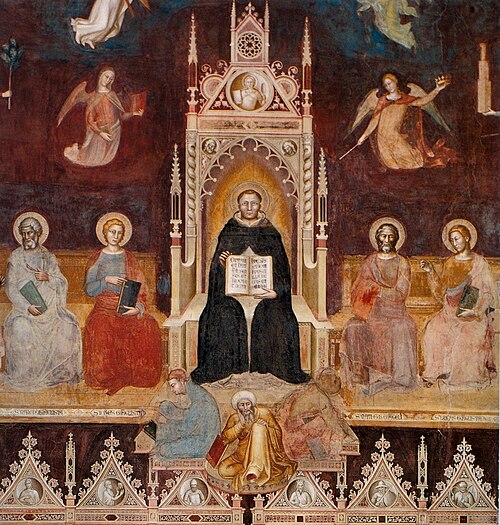

The Great Conversation regarding the nature of the human person finds a singular climax in the thought of St. Thomas Aquinas (1225–1274). Known as the Doctor Angelicus, Aquinas was a Dominican friar whose life’s work involved reconciling the newly rediscovered Aristotelian corpus with the established Augustinian theological tradition. Born into a noble family in Italy, he famously defied his family’s wishes in order to join the mendicant Dominicans, eventually studying under Albert the Great. His career at the University of Paris was marked by a relentless pursuit of truth through the disputatio method—a pedagogical practice that valued the rigorous weighing of opposing arguments to reach a clear synthesis.
Aquinas’s project is characterized by a profound confidence in the harmony of faith and reason. Where previous thinkers often felt forced to choose between the biological realism of the Greeks and the spiritual interiority of the Church Fathers, Aquinas constructed a metaphysical framework that allowed both to coexist without contradiction. His dialectical method aimed to reconcile tensions in the tradition, and the competing frameworks for the human soul were a prime target for his analytical gaze.
In his Summa Theologiae, he resolves the ancient tension between the soul as a “ghost in the machine” and the soul as a mere biological function, presenting a vision of the human being that is at once profoundly physical and undeniably eternal. Aquinas is uniquely able to do justice both to the human soul’s immortality apart from the body and to its God-ordained embodiment as constituting human (as opposed to angelic) nature. For the classical Christian educator, this synthesis is the essential foundation for our pedagogy, providing a road map for the transcendent formation of the whole person.
The Soul as the First Principle of Life
Aquinas begins by grounding his inquiry in the observable world, following the Aristotelian tradition of treating the soul as the “first principle of life.” He writes,
“To seek the nature of the soul, we must premise that the soul is defined as the first principle of life of those things which live… it is the ‘first’ principle of life, which we call the soul.” (ST I, q. 75, a. 1)
Note how, like Aristotle, Aquinas is using the original linguistic meaning of the term ‘soul’ (anima in Latin) for that which animates a living being. He is not merely premising that Aristotle was right, he is applying Aristotle’s method of beginning with common sense notions, before applying philosophical rigor to resolve misunderstandings and contradictions on the road to a productive synthesis.
This Aristotelian definition immediately moves us away from the materialist errors of Epicurus and Chryssippus; as Aquinas argues, “nothing corporeal can be the first principle of life” (ST I, q. 75, a. 1). Life is not a property of matter qua matter; if it were, every stone and drop of water would be alive. As noted in the Stanford Encyclopedia of Philosophy, Aquinas does not ascribe “some special sort of spirituality to plants and animals” simply by giving them souls; rather, he treats the soul as the internal explanation for the existence and unity of any living substance (Pasnau, “Thomas Aquinas,” §5).
In essence, Aquinas begins by endorsing Aristotle’s hylomorphism, in which the soul of any living body is its substantial form (hyle meaning ‘matter’ and morphe ‘form’). Aquinas uses the non-living example of a bronze statue, in which the bronze material represents the matter with the potential to become a statue, but it is the form that makes it in actuality a statue. Applied to living beings, the soul is the form that provides the organizing principle of the physical matter making up the body. In the human case, this “first principle of life” takes on a unique character because the soul’s powers—such as memory, reason, and will—are “really distinct from the soul’s essence” (ST I, q. 77, a. 1).
This distinction provides a vital corrective to the “blank slate” of Behaviorism or the “id-driven” determinism of Freud. While Freud saw the person as a battleground of unconscious drives, Aquinas sees a unified essence with distinct powers that can be ordered toward flourishing. Because the student is more than the sum of their biological urges or academic performance, the educator realizes that the soul’s essence is an actuality that we do not “create,” but rather whose powers we must activate through habit and grace. We do not educate mere brains or conditioned organisms; we cultivate the powers of a living soul.

The Hylomorphic Union: Improving on Plato and Aristotle
For the educator, the most vital contribution of Aquinas is his insistence on the radical unity of the human person. While Plato often spoke of the soul as a prisoner in a tomb, Aquinas asserts that the soul is the “substantial form” of the body. He writes, “The intellectual soul, by virtue of its very being, is united to the body as its form” (ST I, q. 76, a. 1). This represents an advance beyond previous theories because Aquinas avoids the “notoriously difficult” dualism that treats the body as a mere tool or hindrance (see Fisher, Abstract). As analyzed by Kendall Fisher in her dissertation at Syracuse University, the human being is “unqualifiedly one” (unum simpliciter), a single unified substance where “the existence of the whole composite is also the existence of the soul” (ST I, q. 76, a. 1, ad 5).
In the Thomistic view, you do not merely have a body; you are a body, animated by a rational soul. This hylomorphic view offers a profound metaphysical foundation for the appropriation of modern neuroscience in classical Christian education. While many neuroscientists fall into a “reductive physicalism”—claiming the mind is just the brain—Aquinas allows us to see that the brain is the necessary biological organ through which the soul expresses many of its powers. Yet, as we will see, the soul nevertheless is not dependent on the brain for its existence, nor is it confined to physicality.
At the same time, this hylomorphic unity protects the classical school from the Platoninic Gnosticism of modern digital education, which treats the physical presence of the student as incidental. If the soul is the form of the body, then the environment of the school—the architecture, the physical books, and even the posture of the student—matters. As Aquinas notes, “the phantasm [sensory image] is to the intellect what color is to the sight” (ST I, q. 75, a. 2, ad 3). Because the soul is designed to function through the body, learning must begin in the senses. We are not downloading information into a spirit; we are training a composite being whose “intellect requires the body for its operation” (ST I, q. 75, a. 7, ad 3).

The Subsistent Spirit: Improving on Aristotle and Augustine
While Aquinas tethered the soul to the body more firmly than Plato, he also defended its incorporeality more rigorously than a limited reading of Aristotle might allow. He identifies the “intellectual principle” as something that “has an operation per se apart from the body” (ST I, q. 75, a. 2). Because the mind can contemplate universals—concepts like justice or mathematical principles that are not bound by time or space—the principle behind that thought must itself be immaterial. This leads to the climax of the Thomistic synthesis: the soul is a subsistent form. It is the only form in the universe capable of surviving the dissolution of the matter it informs. Aquinas argues:
“The intellect apprehends existence absolutely, and for all time; so that everything that has an intellect naturally desires always to exist. But a natural desire cannot be in vain. Therefore every intellectual substance is incorruptible.” (ST I, q. 75, a. 6)
This syllogism of Aquinas resonates with the statement of the Preacher in Ecclesiastes, that God “has put eternity into man’s heart” (Eccl 3:11 ESV). The soul’s “subsistence” thus provides an appropriate rationale for why the intellectual soul survives the body even though its very nature was made for union with the body. As the Stanford Encyclopedia clarifies, while the soul’s essence has an “actualizing role,” its “ongoing existence” after death is possible because the intellectual power is “not the act of the body” (Pasnau, “Thomas Aquinas,” §5). This ensures that when we educate for the “vision of the mind,” as we discussed in the article on Augustine, we are tending to a substance that “retains its own existence after the dissolution of the body” (ST I, q. 75, a. 6, ad 2). We are not merely training for temporal success, but for the beatitude that the soul naturally craves.

We might wonder, if the soul relies on the senses and the physical organs of the body (like the brain) for thinking and memory, how then can the soul continue to think and remember after the dissolution of the body? While we might fear that the dissolution of the physical brain signals the end of the mind, Thomas Aquinas offers a technical resolution through his doctrine of the soul’s subsistence.
He acknowledges that during this life, the intellect depends upon the brain’s internal senses to provide “phantasms”—the raw sensory data from which we abstract knowledge. However, Aquinas clarifies that the body is necessary only as an object of thought, not as its instrument, because the act of understanding is fundamentally incorporeal. Consequently, upon the death of the body, the soul adopts a different mode of cognition, receiving knowledge through “infused species” from God rather than through sensory abstraction. While the ability to develop further sensory memories perishes because tied to the organ, the intellectual memory of universal truths persists within the soul’s own substance and God sustains the soul’s sensory memories of its earthly life within the soul.
For the classical educator, this conclusion reinforces the student’s identity as an “immortal and eternal” intellect whose capacity for truth is not merely a biological byproduct but a per se operation of a subsistent spirit. As Aquinas explains, “nothing can operate per se unless it subsists per se,” ensuring that the rational soul remains a unified spiritual agent even after its “mortal and frail body” has fallen away (ST I, q. 75, a. 2). At the same time, the fact that the human soul is “specifically incomplete” without the body necessitates the Christian doctrine of the resurrection for complete human blessedness.

The Workshop of the Intellect: Aquinas and the Phantasm
This detailed theological and metaphysical explanation of the nature of the human soul brings with it a profound understanding of learning and the intellect. To understand how the soul actually learns, we must look to the phantasms (phantasma)—the indispensable bridge between the physical world and the spiritual mind during our earthly existence. While Aquinas adopts Aristotle’s famous dictum that “the soul never thinks without a phantasm,” he expands this into a sophisticated theory of the “turning to the phantasms” (conversio ad phantasmata; ST I, q. 84, a. 7). For the educator, this is a revolutionary psychological claim: the highest reaches of human reason remain forever tethered to the ground of sensory imagination.
A phantasm is not merely a memory, but an internal sensory image produced by the imagination from data gathered by the five senses. When a student looks at a triangle on a chalkboard, they receive a physical sensation. When they close their eyes and still “see” that specific triangle, they are viewing a phantasm. This image is individual, material, and specific.
Aquinas explains that because our intellect is immaterial, it cannot “touch” these material images directly. Instead, he posits the Agent Intellect—a “light” within the soul that shines upon the phantasm. This light “strips away” the individual traits (the specific size or color of that one triangle) to abstract the universal essence, or quiddity. As Aquinas notes, the proper operation of the soul in this life is to understand through a phantasm, and “there is no phantasm without the body” (ST I, q. 75, a. 6, ad. 3). Without the phantasm providing the “raw material,” the Agent Intellect has nothing to illuminate; without the light of the intellect, the student remains trapped in mere sensory observation.
This Thomistic view of the phantasm suggests several profound applications for education:
- The Workshop of the Imagination: In a Thomistic framework, the imagination is the “workshop” where the intellect does its work. If a student’s internal library of images is “starved” or cluttered with low-quality input, the intellect lacks the necessary material for clear abstraction. We must feed the imagination with rich phantasms—great stories, nature study, and fine art. (For more on this, see The Role of Imagination in Education)
- The Order of Learning: We often err in teaching by providing abstract definitions before students have the phantasms to support them. True learning must follow the soul’s natural order: from the sensible to the intelligible. We do not begin with the definition of justice; we begin with the phantasm of a shared loaf of bread or a fair game, allowing the student’s intellect to abstract the truth from the experience. The same principle applies in mathematics where we should proceed from concrete to pictorial to abstract.
- The Body-Soul Pedagogy: Because Aquinas views the human person as a hylomorphic unity, thinking is a total-person event. We are not ghosts in machines that can ignore our bodies. Physical posture, the beauty of the classroom environment, and the quality of sensory materials are not extras—they are the very soil from which the “intelligible species” grows.
Conclusion: The Soul of Education
In the “phantastic” bridge of the Thomistic synthesis, the soul of education finds its clearest mandate. We educate the student as a hylomorphic union—a unified being whose physical habits, neurological pathways, and sensory phantasms are the essential gateway to the transcendent truth. This study of the soul reveals that we must cultivate the imagination as the vital soil in which the seeds of the intellect grow.
Aquinas teaches us that the soul’s “natural inclination to be united to the body” (ST I, q. 76, a. 1, ad 6) is not a limitation to be overcome, but the very mechanism of our growth. Our pedagogy must therefore be Thomistic in its balance: it must be rigorous in its physical and sensory disciplines—valuing the phantasms of stories, pictures, and concrete experiences—yet always oriented toward the transcendent end of the person. We are not merely training for temporal success, but for the eternal beatitude that the soul naturally craves. By tending to the sensory roots, we prepare the student for a fullness of existence where the “vision of the mind” finally meets the unchanging truth that lies behind every image.
Bibliography
Aquinas, Thomas. Summa Theologiae. Translated by the Fathers of the English Dominican Province. Second and Revised Edition. 1920.
Pasnau, Robert. “Thomas Aquinas.” In The Stanford Encyclopedia of Philosophy, edited by Edward N. Zalta. Winter 2022 Edition. Metaphysics Research Lab, Stanford University, 2022. https://plato.stanford.edu/entries/aquinas/.
Fisher, Kendall. “Thomas Aquinas on the Metaphysical Nature of the Soul and its Union with the Body.” PhD diss., Syracuse University, 2015.

Leave a Reply