
In this series, we have been working like the Stoic Athenodorus, following the ghost of our philosophical assumptions about the soul out into the courtyard of ideas to discover what must be retained and what must be reburied. We have engaged with Plato’s immortal and tripartite soul, and explored Aristotle’s integrated hylomorphism, where the soul is the form of the living body. We then looked into Epicurean materialism, finding in its atomic structure a profound ancestor to modern secular materialism.
Now we turn to Stoicism, a philosophy that, like its rival Epicureanism, defined the soul physically but placed an absolute moral imperative upon the rational faculty. This Stoic emphasis on the perfection of reason and the rigorous training of the will provides a powerful framework for dissecting moral responsibility in the classical Christian tradition of education. To the student raised in a modern, impulsive culture, the Stoic ideal might sound familiar, perhaps echoing the ascetic philosophy of the Jedi in Star Wars—a disciplined order whose moral strength comes from rational detachment and alignment with a cosmic organizing force, just like ancient Stoicism.
In recent years we’ve witnessed a resurgence of Stoicism in popular culture, with figures like Ryan Holiday, bestselling author of books like The Obstacle Is the Way and Ego Is the Enemy, leading the way through his blog and Daily Stoic podcast. In addition, Donald Robertson, a cognitive behavioral psychotherapist, has written explicitly on the overlap between Stoic philosophy and Cognitive Behavioral Therapy (CBT), which its originators also directly connected to ancient Stoic thought. CBT is an action-oriented psychotherapy based on the Stoic principle that psychological distress arises not from external events themselves, but from a person’s judgments of those events. Its core technique, cognitive restructuring, is a direct clinical application of the Stoic discipline of assent, teaching patients to identify and challenge dysfunctional beliefs to cultivate more rational and adaptive emotional responses.
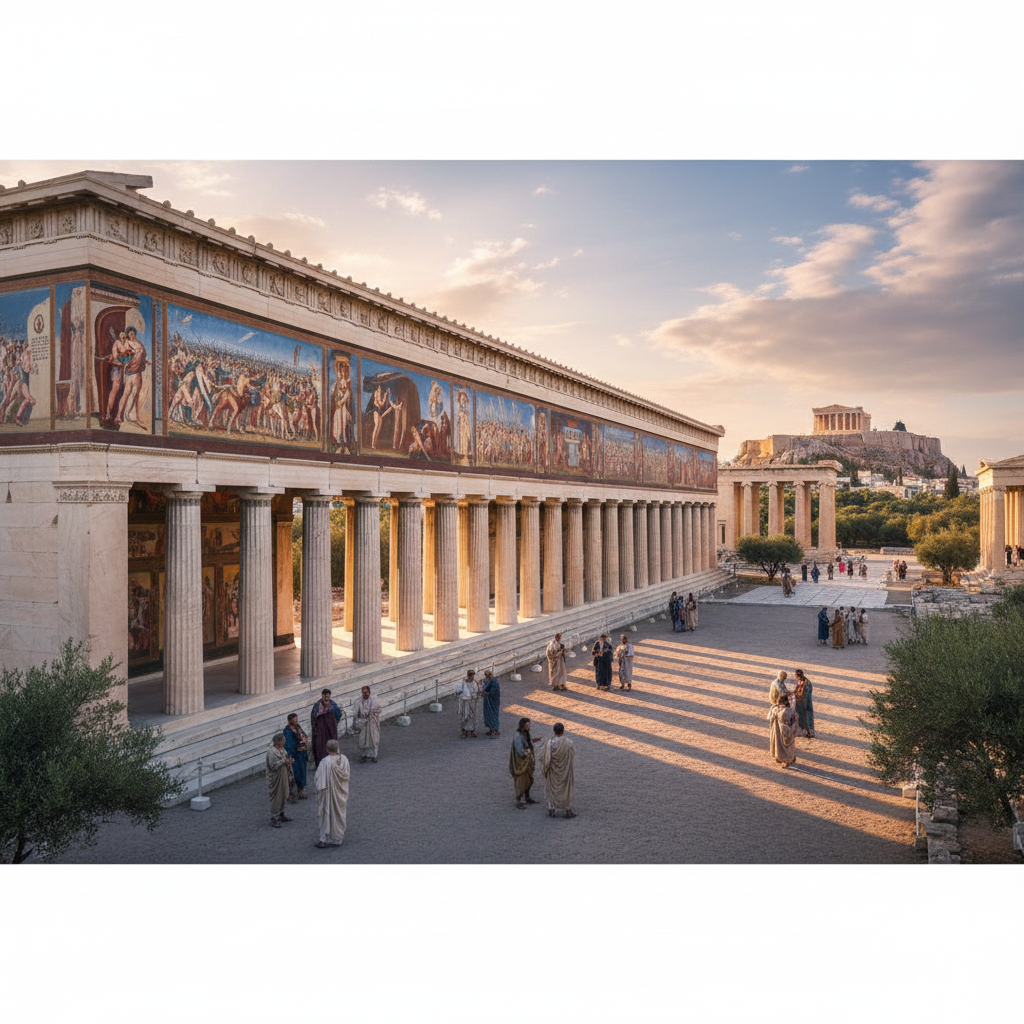
This contemporary cultural parallel to ancient Stoicism suggests a deep human longing for order that the Stoic system, with its focus on self-control (enkrateia), attempts to fulfill entirely through rational effort. Stoicism was founded by Zeno of Citium around 300 BC; its name derives from the porch or stoa in the Agora of Athens, under which the first generation of Stoics gathered for discussion and lectures. As with Plato, Aristotle and Epicureanism, we will see in the Stoic view of the soul both areas of fruitful insight and also unhelpful dead ends for classical Christian educators in leading the souls of our students to wisdom, virtue and faith.

The Corporeal Soul and the Unified, Octapartite Hegemonikon
Perhaps surprisingly, the Stoic system is founded on a radically corporealist ontology, which we could critique in much the same way we did the Epicurean view. Stoics assert that only bodies exist because only bodies possess the capacity to act or be acted upon. This fundamental commitment to materiality dictates that the soul (psychē) must be a body of a certain kind. Specifically, the Stoics defined the soul as pneuma—a term that may be known to Christians as the New Testament term for ‘spirit’, but which the Stoics defined as a fiery, warm breath. This unique physical substance is present in different gradations throughout the universe (much as the Force of the Star Wars universe is mediated through midichlorian count), holding together rocks and accounting for plant life, but culminating in its highest degree in the soul. Stoics argued that if the soul were incorporeal, it could not physically interact with the body, such as causing cheeks to blush during shame or enabling the body to feel pain. Their emphasis on causal contact leads to the conclusion that the soul must be corporeal, since the soul and the body it animates are in constant contact.
In a crucial break from Plato’s segmented, tripartite soul (rational, spirited, and appetitive), Stoic psychology is strictly monistic, holding that all psychic functions originate from a single, central faculty. This central power is called the hegemonikon or ruling faculty, located physically in the chest or heart, which serves as the seat of reason, judgment, assent, and impulse. The Stoics explicitly reject the Platonic and Aristotelian approach that posits non-rational sources of motivation in the mature human soul, which might oppose the dictates of reason. Consequently, moral conflict or a lack of self-control (akrasia in Greek philosophical terminology) is not seen as a battle between separate parts, but rather as an error or defect within the unified rational mind itself.
The complete psychē operates through eight distributed powers, with the seven peripheral parts acting merely as physical extensions radiating from the central hegemonikon. Those familiar with important Stoic authors like Seneca, Epictetus and Marcus Aurelius might be surprised by this octapartite view of the soul, which is not mentioned explicitly in their writings. But these famous Stoics lived much later than the founding thinkers, Zeno, Cleanthes and Chrisippus, from whom we have almost no full standalone works. Instead, we are reliant for our understanding of early Stoicism on the brief quotations and summaries of later authors. It is almost certain that the Stoicism of those later writers had experienced some shifts in emphasis and even updated specific doctrines. Diogenes Laërtius records the eightfold division of the soul from Chrissippus:
“They hold that the soul is corporeal, and that after death it is perishable, though the soul of the universe, of which the individual souls of animals are parts, is indestructible… The parts of the soul are eight: the five senses (sight, hearing, smell, taste, touch), the faculty of speech, the reproductive faculty, and the hegemonikon (ruling part).”
–Diogenes Laërtius, Lives of Eminent Philosophers, Translated by R. D. Hicks, Vol. 2, Loeb Classical Library 185; Cambridge, MA: Harvard University Press, 1925; Book VII, §157
The logic of this eightfold soul becomes apparent when we consider how the principle of life is active in our senses, our voice and through reproduction. Rather than some sort of mystical theory, the Stoic view of the soul thus applies a common sense assumption that connects a material soul through the parts of the body most associated with consciousness and perception.
The central location and monistic function of the hegemonikon are reinforced by the critiques of later Platonists, such as the physician Galen (129 – c. 216 AD). Galen, aiming to attack the Stoic idea of a unified soul, nonetheless provides evidence for the Stoic position that all impulses and judgments are centralized. He notes that the Stoics located the dominant part of the soul in the heart because this region is where the affections of the spirited part (thumos: chest or heart) arise. Galen himself rejects the Stoic claim that the spirited and rational parts must be the work of one power. This later report confirms that for the Stoic, the mind is not composed of separate entities fighting for control, but is a singular, rational body that directs all sensation and action, and therefore bears total responsibility for its failures.

The Rational Imperative and the Nature of Passion
The monistic structure of the soul leads directly to the core of Stoic ethics: the absolute moral centrality of assent (Greek sunkatathesis). Assent is the function unique to the rational soul that enables us to evaluate and pass judgment on our incoming impressions, making it necessary for rational creatures to adopt a critical stance toward the world. The Stoics insist that assent is the primary duty within our power in a way that the initial reception of an impression is not. This concept is almost identical to Charlotte Mason’s “way of reason” in the synopsis of her educational philosophy, where she warns that the initial reception or rejection of an idea is critical, since the reason is capable of finding “proofs” to justify whatever course we are already inclined to take (see principle 18 of the preface to vol. 6 Towards a Philosophy of Education, AmblesideOnline, xxxi). Our moral status, then—whether we are virtuous or vicious, knowledgeable or ignorant—depends entirely on these voluntary acts of assent, thus providing a strong philosophical mandate for focusing education on personal moral and epistemic responsibility.
Going one step further, Stoic intellectualism defines the passions (pathē) not as unruly, non-rational forces (like the black, appetitive horse in Plato’s Phaedrus), but as the products of rational error—excessive impulses or movements of the soul that are irrational and contrary to nature. The Stoics viewed passions as movements of the single, rational mind or will resulting from what we might call cognitive mistakes. The medical writer Galen, despite his opposition to the Stoic model, confirmed this definition while attempting to refute it:
“Chrysippus… maintains that the dominant part of the soul [the hegemonikon] is located in the heart, and he defines the passions as bad judgments of the dominant part….” –Galen, On the Doctrines of Plato and Hippocrates, Edited and translated by Phillip De Lacy, 3rd ed.; Berlin: Akademie Verlag, 2005; Book V, 1-3
A passion, such as fear (perceiving some future harm or threat), arises when the hegemonikon assents to the false proposition that an external indifferent (like illness or poverty) is genuinely bad, meaning that it is destructive to one’s inner happiness. In a way this process is coherent with the Platonic tradition, in that true knowledge is sought as the antidote to evil and error alike. The Stoic goal is the eradication of such passions, resulting in apatheia or freedom from harmful emotions, by correcting the cognitive error in judgment. This perfection of the rational faculty is virtue, which the Stoics hold to be the only true good which is both necessary and sufficient for happiness.
For the Stoic soul, then, the ethical goal or telos is happiness (eudaimonia), achieved by aligning the individual’s perfected reason with the cosmic order, which the Stoics identified with the divine active principle of the universe, or eternal reason (logos). The flourishing agent thus lives in conformity with the nature of humanity and of all things. Diogenes Laërtius provides the famous formulation of this end:
“Therefore, living in agreement with nature comes to be the end, which is in accordance with the nature of oneself and that of the whole, engaging in no activity wont to be forbidden by the universal law, which is the right reason pervading everything and identical to Zeus, who is this director of the administration of existing things.”
-Diogenes Laërtius, Lives of Eminent Philosophers, Book VII, §88 (Cited in Stanford Encyclopedia of Philosophy, 63C)
This rational imperative is strikingly similar to the governing philosophy of the Jedi, who seek to eliminate fear and impulse by strictly adhering to the will of the Force—an omnipotent energy field that binds all things together (much like the Stoic pneuma) and whose will is absolute logos. Both systems demand absolute self-mastery by rejecting the chaotic demands of external goods and relying solely on internal rational commitment. The Stoic wise person or sage is maximally happy and virtuous even while being tortured on the rack (Cicero, De Finibus 3.42)–a Platonic conception from the Republic which went decisively too far for Aristotle–because their virtue (equated with knowledge) is independent of external circumstances, which are mere indifferents (adiaphora).

Christian Critique: The Pneuma–Psychē Reversal
The Stoic system is a powerful tool for emphasizing rational self-mastery, but its metaphysical foundations create sharp conflicts with the Christian worldview, particularly concerning the nature and destiny of the soul.
The Stoics defined pneuma (the Greek word for spirit in the New Testament) as the universal, active, material substance (Cosmic Logos) that is the source of all things, while the individual psychē (soul) is merely a material fragment of this cosmic pneuma. This pantheistic mindset involves obvious contradictions with a biblical theology of God’s transcendence and otherness. In a similar fashion, Stoicism’s radically materialist ontology is fundamentally opposed to a Christian anthropology, which views the rational soul (psychē) or spirit (pneuma) as a non-material entity. While God does breathe into the man the breath of life in Genesis 2:7, this was by and large not interpreted in a crudely physical way within the Judeo-Christian tradition.
Furthermore, the Stoic psychē is mortal and perishable, contradicting the Christian affirmation that the soul is created for continued existence after physical death, and ultimately in resurrection or punishment at the final judgment. Their belief in the soul’s mortality led Epicureans and Stoics to philosophize for the purpose of banishing the fear of eternal punishment, but the Christian faith maintains a more total accountability for each immortal soul: “And do not fear those who kill the body but cannot kill the soul. Rather fear him who can destroy both soul and body in hell” (Matt 10:28 ESV).
Further, the Christian distinction between pneuma and psychē draws attention to the need of the individual human soul for redemption from outside of itself, rather than a discovery of its own oneness with the pervading force of the universe. In the New Testament pneuma refers primarily to the Holy Spirit, who is the transcendent, immaterial and personal third person of the triune Godhead. The human psychē, on the other hand, is the natural life and personality as tied to a human body, which, although inherently rational (created as the imago Dei), is flawed by corruption, as evidenced by the inner conflict Paul describes in Romans 7.

Unlike in Stoicism, the soul is not equivalent to the human pneuma, which refers instead to the highest and immaterial part of the human person that is receptive to the divine. For Paul, the soulish or psychikos man (often translated ‘natural’) does not understand the things of God and cannot (see 1 Cor 2:14). In Christianity the human soul is insufficient, not itself a fragment of the divine, even if it owes its living nature to divine creation. The Stoic sage, on the other hand, is self-sufficient, achieving virtue by his own perfected reason, through its inborn connection to the pneuma. In contrast, the Christian requires the Divine Pneuma to sanctify the psychē, acknowledging that true strength for virtue comes from outside the hegemonikon itself: as Paul proclaims paradigmatically, “I can do all things through him who strengthens me” (Philippians 4:13 ESV), indicating in context that the secret of attaining contentment (certainly a Stoic goal as well) can only be attained through divine resources given above and beyond natural human ones.
Classical Christian Pedagogy: The Discipline of Assent
Despite these crucial theological differences, the Stoic focus on assent—the moment the mind chooses whether to validate an impression, impulse or idea—is deeply resonant with the classical and Christian mission to cultivate character and self-control through education. The Greek virtue of enkrateia, defined by Socrates’ disciples as the “foundation of all the virtues,” emphasizes the virtuous self-mastery that classical Christian education seeks to instill in students. For Christians, this virtue of self-control is called a fruit of the Pneuma by the apostle Paul (see Gal 5:22), and therefore a proper goal of our Spirit-empowered educational efforts, as parents and teachers bring up their children in the paideia (discipline or cultural education) and nouthesia (warning or instruction) of the Lord (see Eph 6:4).
Charlotte Mason affirmed this pedagogical goal, insisting that character requires strengthening the student’s inner resolve:
“We who teach should make it clear to ourselves that our aim in education is less conduct than character; conduct may be arrived at, as we have seen, by indirect routes, but it is of value to the world only as it has its source in character. . . . it is time that we realised that to fortify the will is one of the great purposes of education.”
-Charlotte Mason, Toward a Philosophy of Education, Vol. 6, AmblesideOnline, p. 129
This goal requires for Mason not only the way of the reason, but also the way of the will, which she calls “two guides to moral and intellectual self-management” (128).
The Stoic system provides a practical and philosophical structure for this self-management or fortifying process by framing moral failures (passions) as intellectual failures (bad judgments). Within a Christian frame of reference, we can still draw strength from this paradigm since sin too represents, in all cases, an actual failure of true Spirit-enabled judgment; it involves a cognitive mistake, giving in to the temptation to believe that sin is more beneficial to the soul than humble obedience to divine command, in which is found true blessedness. This mandate can then translate into a pedagogy of assent in the classical Christian classroom or homeschool, as we focus on training the hegemonikon or rational will of our students to assent only to truth and reject falsehood, thereby aligning the student’s mind with God’s rational created order.
To guide students in this demanding work, educators must adopt specific strategies that focus on the internal sphere of control. Three important pedagogical practices to fortify the will and thereby develop the Christian intellectual and moral virtue of prudence are 1) challenging hidden judgments, 2) developing cognitive control, and 3) prioritizing necessary truth.
- Challenging Hidden Judgments
When a student expresses a destructive passion (like anger or despair), the Stoic perspective directs the educator to look past the emotion and expose the underlying false judgment that the hegemonikon assented to. For instance, disappointment over a low grade is rooted in the false judgment that an external indifferent (reputation/grade) is essential to personal worth (a genuine good), which is found only in Christ. The classical Christian teacher, operating under the mandate of the transformation and renewal of the mind (see Rom 12:2), must help the student recognize this cognitive error and re-evaluate the indifferent, thereby carrying out the apostolic call to take every thought captive to Christ (see 2 Cor 10:5).
In this way the teacher or mentor helps the student learn self-management through the practice of evaluating his or her own hidden assumptions in light of the truths that they accept. The fact of the matter is that while we may believe certain fundamental truths, in actual situations our will may assent to ideas or emotions that are in contradiction with our stated beliefs. Christian sanctification requires a process of challenging these hidden judgments over time.
- Developing Cognitive Control
The Stoic focus on assent finds modern validation in positive psychology and neuroscience, which emphasize cognitive control. When intense desire activates the reward pathway, leading to impulsive action, this is, in Stoic terms, a failure of the hegemonikon to exercise selective attention. Teaching students to maintain “bright lines” (pre-commitments) and intentionally “create a diversion” by redirecting their attention toward wholesome, varied interests, as Mason advocated, calling it “the way of the will,” are precisely the practical techniques needed to strengthen the will’s capacity for rational assent over impulsive desire.
I have unpacked the power of diversion and precommitments for developing self-control before on Educational Renaissance (see Educating for Self-Control, Part 1 and Part 2). In short, the Stoic focus on self-control is explicitly endorsed in the New Testament, albeit with different fundamental theological underpinnings. These two tools of precommitment and diversion, endorsed by Mason and recent findings on will power and neuroscience, provide helpful resources for the development of cognitive control. This represents part, but not all, of a mature Christian’s ability to resist temptation and display the fruit of the Spirit in self-control.
- Prioritizing Necessary Truth
The Stoic doctrine of indifferents ensures that the education remains focused on the highest pursuits. By insisting that health, wealth, and pain do not affect true or ultimate happiness, the Stoics provide a rigorous model for justifying the classical Christian educational mission to educate students for the contemplation of necessary, unchanging truth (implying Aristotle’s intellectual virtues of epistēmē and nous). Christian theological truths like the eternal realities of God, salvation and final judgment do not discount this line of thought; if anything, they raise the stakes. This rational and spiritual pursuit, rather than mere preparation for success in the changing, contingent world, provides the ultimate goal, which, when pursued rightly, leads to the mental quietude (schole) sought by Epicureans and Stoics alike, which is also necessary for deep learning.
The Christian and classical school will thus prioritize training the mind in logic, philosophy and theology, not as a set of electives to an otherwise complete education that is intended primarily to prepare graduates for the marketplace. Rather, as was the case in the Middle Ages and Renaissance, these studies that prioritize the highest truths function as the reigning Queen of the Sciences, the privileged center of the curriculum. The ultimate good sought here is the highest intellectual virtue of philosophic wisdom or sophia (in Aristotelian terms), not mere practicality.
The Stoic view of the soul, while incomplete in itself, provides a potent rational imperative for classical Christian educators, demonstrating that true self-mastery is a cognitive achievement, as well as a fruit of the Spirit, which requires the rigorous cultivation of the will to assent only to truth, thereby eradicating the bad judgments that lead the student to be, as we have said before, enslaved to their own prejudices and appetites. The training of the hegemonikon must be paramount if the student is to avoid the pitfalls of a self-indulgent culture and achieve genuine, lasting human flourishing through the cultivation of practical and philosophical wisdom.
Works Cited
Diogenes Laërtius. Lives of Eminent Philosophers. Translated by R. D. Hicks. Vol. 2. Loeb Classical Library 185. Cambridge, MA: Harvard University Press, 1925.
Galen. On the Doctrines of Plato and Hippocrates. Edited and translated by Phillip De Lacy. 3rd ed. Berlin: Akademie Verlag, 2005.
Mason, Charlotte. Toward a Philosophy of Education, Vol. 6. The Charlotte Mason Digital Collection. AmblesideOnline. Accessed November, 2025.
Stanford Encyclopedia of Philosophy. “Stoicism.” Last modified January 20, 2023.

Leave a Reply